A Farewell to Karaage
Once upon a time, there was an impressive organisation called the Victorian Partnership for Advanced Computing, which was originally established in 2000 to provide supercomputing services to the University sector in Victoria. Unfortunately, the Board decided that VPAC would close its doors in 2015, and the successful experiment in a single provider for university high-performance computing systems came to an end.
During VPAC's existence, the number of researchers who needed supercomputing resources wasn't as high as it is today, and applications for accounts were originally submitted on paper forms. Obviously, this became increasingly untenable as growth pressures mounted, so about fifteen years ago, Sam Morrison designed an account management system called "Karaage". Yes, it was named after the Japanese fried chicken dish, a particular lunch-time favourite from a local dining venue.
Karaage was designed on a Django Python web framework and completely replaced the onerous paper system; "Be nice or I will replace you with a small shell script", as the saying goes. Apart from its implementation at VPAC and the several HPC systems that were managed there, Karaage was also introduced to other HPC centres and universities, especially in 2014-2015, when VPAC was responsible for establishing several HPC systems across the country. Karaage was capable of managing users, projects, groups, and software across multiple clusters. At a rough guess, approximately 20,000 postgraduate researchers across Australia would have had their accouts managed by Karaage.
When it was in operation, VPAC managed the University of Melbourne's HPC system, Edward. When VPAC closed in 2015, Karaage was retained by the University and adopted for the new system, Spartan, which has been the subject of numerous papers, presentations, and a substantial body of research. Spartan was a fascinating experimental system that was sufficiently successful to win a LIEF grant to provide GPU services to a number of Victorian Universities and, in doing so, became one of the world's top-tier systems.
An open-source project, Karaage was also utilised by several other universities and was quite capable of supporting external users (through AAF authentication). It is a testament to its design that, throughout this period, across all installations, there were no significant operational issues. The only significant limitation with Karaage from the Universty's perspective was that it was not fully integrated with the broader bespoke requirements of the University of Melbourn's Research Computing Services, including data and cloud services. Notably, the new RCS portal uses a similar framework for managing accounts. With the RCS Portal, over 10,000 researchers will be able to access and manage their accounts and activities whilst adding data services, virtual machines from the research cloud, and high-performance computing projects through a single interface that connects all the services.
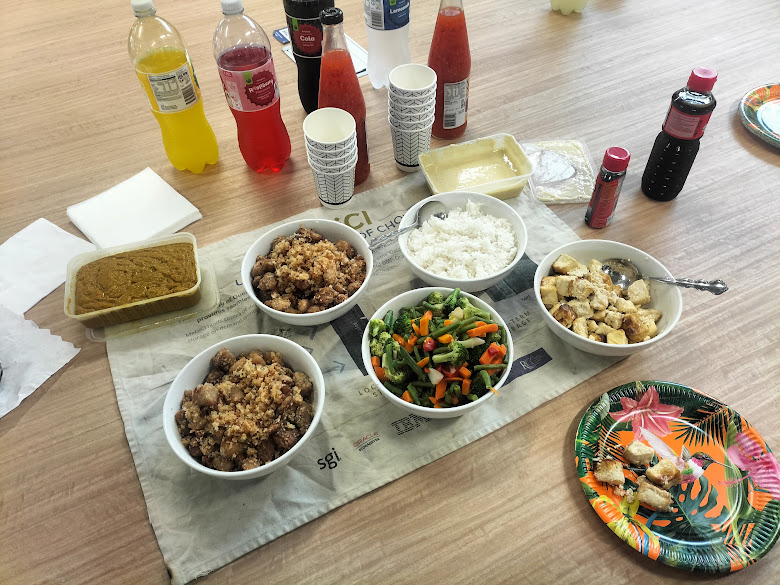
A valedictorian lunch was held for Karaage on Thursday, September 24. Sam Morrison, the original developer of the system and Dr. Brian May, the long-term maintainer, both present. For aesthetic reasons, Karaage chicken (and a few other dishes) were served.