
Ten Years of Daily Duolingo
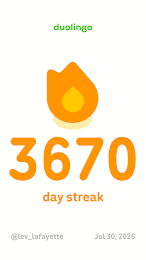 Recently, I passed a ten-year streak of doing Duolingo every day. It's not like I do the bare minimum either; for the past three years, at least, my end-of-year Duo report records me in the 0.1% of learners on their application. My profile lists a rather impossible list of languages, many of which I looked in my early years and, I must admit, were handy whilst travelling through Europe. These days I'm concentrating on standard Chinese and French, whilst last year I completed the Spanish course as I was travelling to South America. In other words, over the years, my language learning has become more functionally-oriented rather than experimental.
Despite this regular use, I have mixed opinions about Duolingo. I will argue that Duolingo is the best language-learning application currently available. Nothing else comes to mind that has an extensive range of courses, that has a similar depth of content, that has regular updates, expansions of content and alignment to CEFR language competence. It continues to improve in areas such as spoken content, grammar, and conversational use of a language.
Likewise, I will also argue that Duolingo is the worst when it comes to business practises. It has built itself on countless hours of willing volunteers who gave advice and highlighted bugs over many years when the free version of the application was useful. Now that Duolingo has reached a position of apparently unassailable market dominance for language learning it has turned the screws to exclude community input (e.g., closing the forums, closing the language incubators) and, with aggressive and often gross advertising, has made the free version of the application almost unusable.
As a result of these practises, Duoling is the most profitable venture of its type. In terms of market evolution, it successfully outmanoeuvred potential alternatives in the competitive stage of the market development by engaging in the highest levels of community input but without providing community empowerment. Now it has reached the stage of market dominance, it has what is erroneously called "competitive advantage" in business studies, but is really "monopolistic advantage" when viewed through the lens of economic analysis.
I am sure the leaders at Duolingo are very well aware of this; whilst they could be true to their origins and actually contribute substantially to such a development, I suspect their business logic will run contrary to it. Duolingo argued that: "Our mission is to develop the best education in the world and make it universally available". They have claimed that: "The freemium business model is good for our mission and our business. We grow by offering an incredible free product and monetize by making the paid version worth it. This fuels a growth flywheel...". The reality is, however, that they don't really have a freemium model anymore.
However, at is core, Duolingo is actually a fairly simple product. In terms of computer design, flashcards (whether words, sentence gaps, etc) are simply an associative array of text and audio, text for grammar with a simple user interface (the simpler the better; Duo's distracting and unnecessary animations are awful) and spaced repetition algorithms. At the moment, numerous community-built Anki cards provide the highest level of development in this regard. Ultimately, however, Duolingo is a very tempting target for a community project, which I think is inevitable, which leads to an interesting conclusion that, in the near future, Duolingo's functionality will be open-sourced.
| Attachment | Size |
|---|---|
 tenyearduo.png tenyearduo.png | 10.31 KB |